Volume VIII · Coming
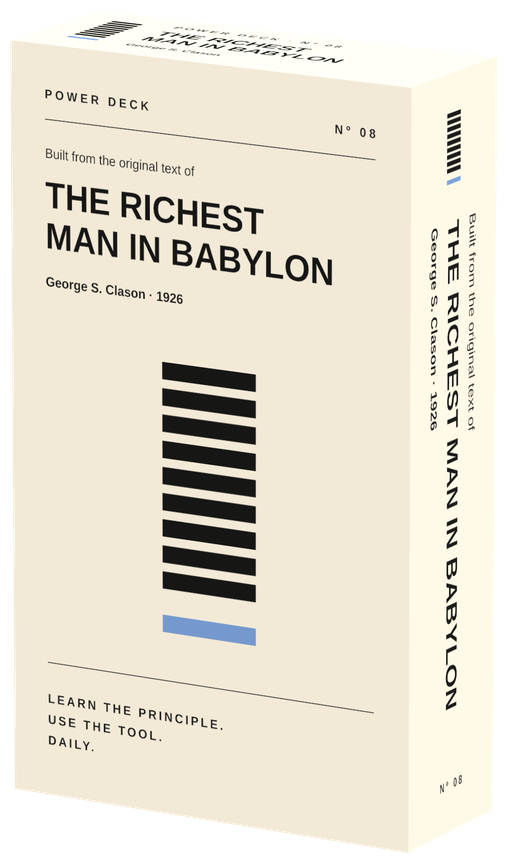
Built from the original text of
The Richest Man in Babylon
George S. Clason · 1926
From earning money to keeping a tenth of it.
The original book, made usable. The book’s own tool, Pay Yourself First, as cards you use daily.
Original text, verbatim · Not yet printed · Nothing is charged
If this is you
You know you should save. You've never made it automatic.
The parables come down to one rule: a part of all you earn is yours to keep, not less than a tenth. It is easy to agree with and easy to skip.
This deck is the rule, handed to you as something you say in the morning, at noon and at night, as Arkad told his friends.
Before
You earn, you spend, and keep whatever is left.
After
You pay yourself first, a tenth at least, every time.
What’s in the box
Everything you need to start today.
- AnchorStart from the keystone.
- StudyWork the author’s words.
- CarryKeep one on you.
- RespondTake one into the day.
54 cards, 16-page field manual, night box.
The book’s own mechanism
Pay Yourself First. Run daily.
A part of all you earn is yours to keep.
Algamish to Arkad · The Richest Man in Babylon
The cards carry the seven cures for a lean purse and the five laws of gold. You just use them.
How to use it
A day with the deck.
Anchor the principle. Study the author’s words. Carry one card. Respond when the moment comes.
About this book
George S. Clason, 1926
First published in 1926, as a set of parables set in ancient Babylon. Seven cures for a lean purse and five laws of gold run through them. The book is in the public domain.
Terms and FAQ
What does Beta Run mean?
The Beta Run is the first printing. It is called a beta so the system can be tested in real hands and perfected before a full first run. It costs the same as every run after it.
Is this the whole book?
No. The deck carries the keystone, the author's own method and the passages that put it to work, in the author's words. It does not reprint the book. Read the book alongside it.
Are the words the author's?
Yes. Every word on a card is the author's, checked against the book. Our words are titles, eyebrows and use lines. They name. They never interpret.